
Teleradiology Services for Hospitals: How They Work and How to Choose a Provider
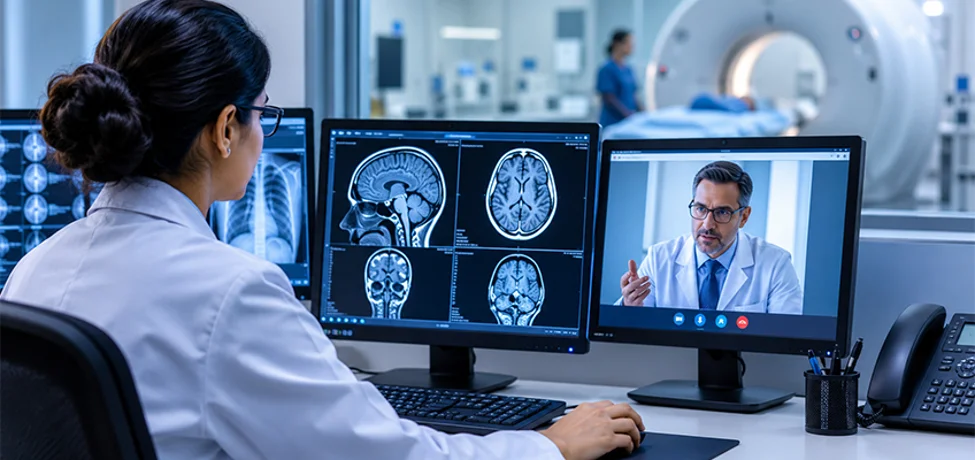
Hospitals rarely lose time to the scanner. They lose it in the gap between a finished scan and a signed report. When a trauma CT is completed in the small hours and the only radiologist has gone home, that gap can shape how quickly a patient gets treated.
Teleradiology exists to close that gap. A hospital sends images, such as X-rays, CT, MRI and ultrasound, to a radiologist at another location, who reads them and returns a signed report. The reader may be in the next city or on another continent. What changes for the hospital is the speed of the answer and the depth of expertise it can reach.
This article examines how teleradiology works in practice, what it costs, where India's rules stand, and what separates a dependable provider from a risky one.
What is teleradiology, and how is it different from radiology?
Radiology is the medical specialty: doctors who interpret imaging to diagnose disease and guide treatment. Teleradiology is not a separate specialty. It is a delivery model for the same work, where the image travels digitally and the radiologist doesn't have to be in the building.
That difference matters for hospitals because it separates where the expertise sits from where the scanner sits. A 60-bed hospital can't realistically hire a neuroradiologist, a musculoskeletal specialist and a breast imager. Through remote radiology, it can borrow all three.
India has a sharp version of this problem. One industry commentary puts the country at roughly 20,000 radiologists for about 1.4 billion people, and the same piece projects the Indian teleradiology market reaching about USD 2.43 billion by 2030. Demand is clearly not going away.
How teleradiology services work, step by step
The technology sounds complicated. The workflow is not.
- Scan: Your technologist completes the study on the CT, MRI or X-ray machine.
- Send: The images, stored in DICOM format, move securely from your system to the provider, usually through an encrypted connection.
- Triage: The provider's platform sorts the study by urgency. Strokes and trauma jump the queue; routine follow-ups wait.
- Read: A radiologist with the right subspecialty opens the images, along with clinical history, and interprets them.
- Report: A signed report returns to your PACS or EMR, ready for the treating doctor.
- Review: Good providers run peer review and audit a sample of reports for quality.
Some hospitals use teleradiology only for nights and weekends. Others outsource all reporting, or use it for subspecialty second opinions. There's no single right model, only the one that matches your volume and staffing gaps.
How does teleradiology work with a hospital's PACS?
Most modern setups don't need you to replace anything. Your PACS, the system that stores and displays your images, already speaks DICOM. A teleradiology provider typically connects to it with a secure gateway or VPN, pulls the studies it needs, and pushes the finished report back, often through HL7 messages to your RIS or EMR.
Some providers bring their own teleradiology software: a cloud viewer, worklist and reporting tool. Others work inside your existing viewer. Before you sign, ask three practical questions: how long integration takes, whether it needs new hardware, and what happens to your workflow if the internet link drops. One Indian provider advertises a go-live within 72 hours with no hardware, which is worth testing against your own IT team's estimate rather than taking at face value.
What do teleradiology services cost?
The honest answer is that it depends, but the pricing model is predictable. Most teleradiology outsourcing is billed per study, with rates varying by modality (X-ray is cheapest, MRI and mammography cost more), subspecialty, urgency and monthly volume. Retainer or fixed-fee deals exist but are becoming rare.
A few reference points, all published by vendors, so treat them as approximate:
- United States: One vendor says teleradiology groups charge around $12 for an average X-ray read, and a market analysis from earlier years suggested preliminary report pricing leveling out around the mid-$40s.
- India: A teleradiology company's 2026 buyer's guide says a fully loaded in-house radiologist costs INR 18-30 lakh a year and notes that locum or visiting radiologists charge roughly INR 200-800 per scan.
The volume math is the part worth remembering. According to that same guide, below roughly 500 scans a month, per-scan teleradiology is almost always cheaper than a salaried hire. Between 500 and 2,000, a hybrid model tends to win. Above 2,000 stable scans a month, an in-house team can pay off, though you'd still want remote cover for nights and rare subspecialty cases. These are illustrative thresholds, not guarantees, so run your own numbers.
Watch for hidden costs: STAT surcharges, fees for addenda or second opinions, integration charges, and extra pay for overnight reads.
Is teleradiology legal in India?
Short answer: it is widely practiced, but the legal footing is less tidy than vendors suggest.
India's Telemedicine Practice Guidelines (2020) legitimised telemedicine broadly. Yet one commentator in Digital Health News notes that no specific provision gives teleradiology a clearly defined legal status, although no law makes it illegal either. In early 2025, a reply to an RTI query, reported by South First, said the NMC's telemedicine guidelines don't permit radiology reports to be authenticated remotely without a doctor's physical presence and supervision. That has left many providers and hospitals asking for formal clarity.
What this means in practice: use a provider whose radiologists hold valid registration with a state medical council, ask how they interpret the current rules, and have your legal or compliance team review the contract. Also check relevant accreditation expectations such as NABH, and equipment rules from AERB where applicable. This is general information, not legal advice.
What licensing or certification do teleradiologists need?
In India, a teleradiologist should hold a postgraduate radiology qualification (MD or DNB) and active registration with a state medical council. In the United States, radiologists are usually board certified, hold a medical licence in the state where the patient is located, and are credentialed and privileged by each hospital they serve. Ask any provider to show these documents, not just promise them.
How to choose the best teleradiology company
Don't start with price. Start with risk. A cheap report that's late or wrong costs far more than a good one.
- Turnaround time, in writing. Ask for separate commitments for STAT and routine studies, and how breaches are handled. Typical ranges are minutes to an hour for emergencies and several hours up to a day for routine reads, but promises vary widely by contract.
- Subspecialty depth. Can they read neuro, cardiac, MSK and pediatric cases with the right specialist, or does everything go to a generalist?
- Final reports versus preliminary. Some providers only give preliminary reads that your own radiologist must finalise. Know which one you're buying.
- Quality assurance. Ask about peer review rates, discrepancy tracking and how you'll see the data.
- Integration and uptime. Request a reference from a hospital with a similar PACS, and ask about downtime procedures.
- Security and compliance. Encryption, access logs, data residency and the regulatory points above.
- Radiologist verification. Licences, board certificates and training should be verifiable.
- Contract flexibility. Avoid long lock-ins until a pilot proves quality.
A sensible way to decide: shortlist three providers, run a four-to-eight-week pilot on a slice of your volume, and compare turnaround, report quality and your own clinicians' feedback.
What is Nighthawk teleradiology?
People search for this name often, and the answer has a twist. NightHawk Radiology, based in Scottsdale, Arizona, was an early US teleradiology company that was acquired by vRad (Virtual Radiologic) in 2010 in a deal reported at about $170 million. vRad itself later joined Radiology Partners in 2020. vRad has also pointed out that a company operating today under the same name in Coral Springs, Florida has no relation to the original. So if you meet a "Nighthawk" in a vendor list, confirm exactly which company you're dealing with.
Teleradiology FAQs: quick answers
What is the difference between teleradiology and radiology?
Radiology is the medical specialty of interpreting images. Teleradiology is the same service delivered remotely, with images sent digitally to a radiologist elsewhere.
How much do teleradiology services cost?
Most providers charge per study. Indicative figures include about $12 for a US X-ray read and INR 200-800 per scan for visiting radiologists in India, but rates change with modality, urgency and volume.
How do you choose the best teleradiology company?
Compare turnaround guarantees, subspecialty coverage, final-report policy, quality assurance, PACS integration, security and verified credentials, then pilot before committing.
What is the turnaround time for teleradiology reports?
Emergency studies are often reported within about an hour or less, and routine studies within hours to a day. Get the exact numbers in your service agreement.
How does teleradiology work with a hospital's PACS?
The provider connects through DICOM and secure networking, reads the studies, and sends signed reports back to your PACS, RIS or EMR, often via HL7.
Is teleradiology legal in India?
It is common and not banned, but formal legal clarity on remote report authentication is debated. Verify registration and get legal review.
The takeaway
As hospitals face growing imaging volumes and persistent radiologist shortages, teleradiology is becoming an increasingly important part of modern diagnostic services. Its value, however, extends beyond remote reporting. The real measure of a successful partnership lies in the quality of interpretation, timely clinical communication, regulatory compliance and seamless integration with hospital workflows. For healthcare providers, choosing the right teleradiology partner is ultimately about strengthening diagnostic capabilities while maintaining the standards of patient care.
 Media Pack Download
 Newsletters
 Industrial Events