
EHR for Hospitals: A Global Guide to EMR, EHR & Interoperability

If you've searched for EHR for hospitals, you're probably past the "what is an EHR" stage. You're trying to figure out what actually separates good hospital EHR software from a system that will frustrate your clinicians for the next decade - and how to choose one without regretting it in 18 months.
This guide covers the practical stuff: EMR vs EHR, interoperability standards, implementation pitfalls, vendor evaluation, and a procurement checklist you can actually use.
What Is an EHR for Hospitals? (Quick Answer)
An EHR (Electronic Health Record) is a digital system that stores a patient's complete medical history - diagnoses, medications, lab results, imaging, treatment plans - and is designed to be shared across multiple providers, departments, and even health systems. Unlike a basic digital chart, a hospital EHR is built for care coordination, not just record-keeping.
For hospitals specifically, EHR software also has to handle things a single clinic never worries about: multi-department workflows, ICU monitoring integration, pharmacy and lab interfaces, bed management, billing at scale, and regulatory reporting across potentially dozens of specialties.
EMR vs EHR: What's the Actual Difference?
This is one of the most searched questions in healthcare IT, and most explanations overcomplicate it. Here's the short version.
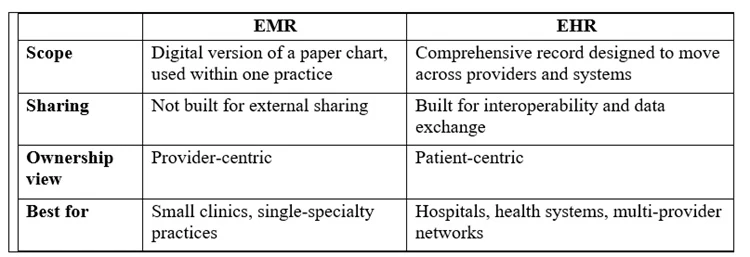
Direct answer: An EMR is a digitized chart for one practice. An EHR is a shareable, longitudinal patient record meant to follow the patient across their entire care journey. For hospitals, EHR is almost always the right category - you're coordinating dozens of departments and often referring patients out to specialists who need that data too.
Why Interoperability Is the Real Battleground
Buying electronic health records for hospitals is the easy part. Making that system talk to your lab vendor, your imaging system, your billing platform, and the hospital across town — that's where most implementations either succeed or quietly fail.
EHR interoperability means different systems can exchange, interpret, and use patient data without manual re-entry. Three standards matter most right now:
- HL7 (Health Level 7): The older messaging standard still widely used for lab and pharmacy data exchange.
- FHIR (Fast Healthcare Interoperability Resources): The modern, API-based standard most new systems are built around. If a vendor can't speak FHIR fluently, that's a red flag in 2026.
- DICOM: The standard for medical imaging, critical if radiology is part of your workflow.
Why it matters practically: poor interoperability leads to duplicate testing, delayed diagnoses, clinician burnout from manual data entry, and billing errors. It's consistently ranked as the top complaint in hospital EHR satisfaction surveys, ahead of cost or training issues.
EHR Implementation for Hospitals: What Actually Goes Wrong
Most EHR implementation for hospitals projects don't fail because of the software. They fail because of the rollout. Common failure points:
1. Underestimating data migration. Legacy records, scanned documents, and years of unstructured notes don't map cleanly into a new system. Budget more time here than you think you need.
2. Skipping workflow redesign. Dropping new software into old workflows creates friction. The best implementations rebuild workflows around the new system, not the other way around.
3. Insufficient clinician training. Physicians and nurses who don't trust the system will work around it - leading to shadow charting and data gaps.
4. No phased rollout. Big-bang, hospital-wide go-lives on a single day are high-risk. Department-by-department or pilot-unit rollouts catch problems before they scale.
5. Weak change management. Clinical staff need a reason to buy in, not just a mandate. Involve department leads early.
A realistic implementation timeline for a mid-sized hospital runs 9–18 months, not the 3–6 months some vendors pitch in sales calls.
EHR Vendor Selection: How to Actually Compare Options
EHR vendor selection is where hospitals lose the most time - and money - if done poorly. Instead of comparing feature lists (most vendors offer similar core features on paper), evaluate on these dimensions:
- Specialty fit — Does the vendor have proven deployments in hospitals your size and specialty mix (general acute care, pediatric, multi-specialty)?
- Interoperability track record — Ask for real FHIR API documentation and existing integration partners, not marketing claims.
- Total cost of ownership — Licensing is one line item. Factor in implementation, training, data migration, customization, and ongoing support fees.
- Uptime and support SLAs — In a hospital, downtime isn't an inconvenience, it's a patient safety issue. Ask for documented uptime history, not promises.
- Regulatory compliance — HIPAA (US), GDPR (EU), or local equivalents depending on your region, plus meaningful use / interoperability mandates where applicable.
- Scalability — Can it grow with additional beds, departments, or a future merger without a full re-platform?
EHR Software Evaluation Criteria: A Practical Framework
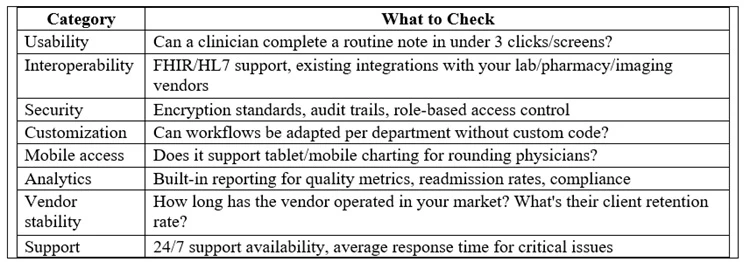
When you're deep in demos, it's easy to be swayed by a polished UI. Use these EHR software evaluation criteria to stay grounded:
EHR Procurement Checklist for Hospitals
Before signing anything, work through this EHR procurement checklist:
- Defined clinical and administrative requirements, signed off by department heads
- Shortlisted vendors with proven hospital-scale (not just clinic-scale) deployments
- Requested references from hospitals of similar size and specialty mix
- Verified FHIR/HL7 interoperability with existing lab, pharmacy, and imaging systems
- Reviewed total cost of ownership over 5 years, not just year-one pricing
- Confirmed data migration plan and timeline with the vendor
- Reviewed uptime SLAs and disaster recovery plans
- Confirmed regulatory compliance for your country/region
- Built a training and change-management plan before go-live
- Negotiated exit terms - what happens to your data if you switch vendors later?
Frequently Asked Questions
What's the difference between EMR and EHR for hospitals?
An EMR is a digital chart used within a single practice. An EHR is designed to be shared across providers and systems, making it the standard choice for hospitals that coordinate care across multiple departments.
How long does EHR implementation take for a hospital?
Most mid-sized hospitals should plan for 9–18 months, covering data migration, workflow redesign, staff training, and phased go-live - longer than most vendors initially quote.
What is EHR interoperability and why does it matter?
It's the ability for different health IT systems to exchange and use patient data without manual re-entry. It matters because poor interoperability causes duplicate tests, delayed care, and clinician burnout.
What should hospitals prioritize when selecting an EHR vendor?
Interoperability track record, specialty-specific deployment experience, total cost of ownership, and documented uptime/support SLAs matter more than a long feature checklist.
Is cloud-based or on-premise EHR better for hospitals?
Cloud-based systems generally offer lower upfront costs, easier updates, and better remote access, while on-premise systems offer more control over data infrastructure - the right choice depends on your IT resources and regulatory environment.
 Media Pack Download
 Newsletters
 Industrial Events